
Last updated: 15 November 2026
What a sorter does
A sorter takes a mixed flow of cartons, totes, parcels or single items, identifies each one, usually by its barcode, and diverts it to a destination such as a shipping lane, a store, a route or an order. It replaces manual sorting, where people read labels and carry goods to the right place.
Sorters are used in parcel and cargo hubs, e-commerce fulfilment centers, store replenishment warehouses and returns handling. The benefit grows with volume: the more items and destinations an operation has, the more time and error a sorter removes.
Main sorter types
Sorters differ in how they carry and divert the item. The common types are:
- Cross-belt sorter: each carrier has its own small belt that runs sideways to discharge the item. It handles a wide product range gently, including polybags and small or irregular items, and suits high volumes with many destinations.
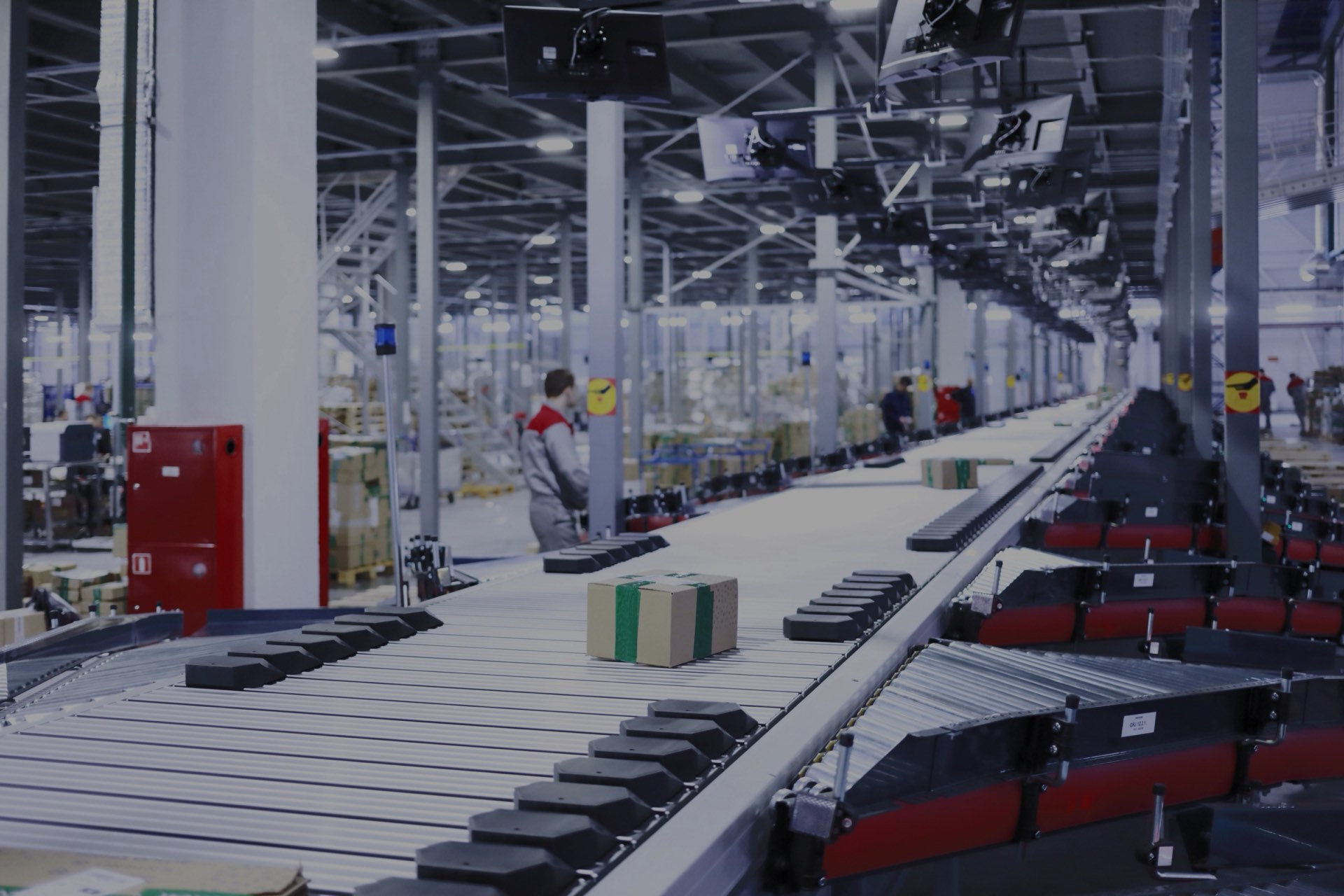
- Sliding-shoe sorter: shoes slide across the conveyor surface and push the item diagonally into a lane. It is a proven choice for cartons and totes with a flat base, in a straight-line layout.
- Tilt-tray sorter: the item rides on a tray that tilts at its destination. It is used mainly for parcels and robust products.
- Push-tray sorter: the item rides on a flat tray, and a pusher on the carrier moves it sideways into its destination. Because the item is pushed rather than tipped, discharge is controlled; it handles a wide range of parcels, including heavier and irregular ones.
- Wheel and belt diverters (pop-up wheels, swivel wheels, narrow belts): diverting units built into a conveyor line. They suit medium volumes of cartons and totes and a smaller number of destinations.
- Pusher and arm diverters: simple units that push the item off the line. They are suitable for lower rates and sturdy packaging.
- Split-tray (bomb-bay) and pouch sorters: specialised types for small, flat or hanging goods such as apparel, often used in e-commerce and returns.
Comparison of the most common types
| Type | Typical products | Typical layout | Suited to |
|---|---|---|---|
| Cross-belt | Parcels, polybags, small and irregular items, cartons | Loop or line | High volumes, many destinations, mixed product range |
| Sliding-shoe | Cartons and totes with a flat base | Straight line | High volumes of cartons, shipping and store sortation |
| Tilt-tray | Parcels and robust items | Loop | Parcel and cargo operations |
| Push-tray | Parcels of mixed size and weight, including heavier and irregular items | Loop | Parcel and cargo operations with a wide product range |
| Wheel or belt diverter | Cartons and totes | Built into a conveyor line | Medium volumes, fewer destinations |
The right type follows from the products and the volume, not the other way round. Two operations with the same hourly volume can need different sorters because their products differ.
How to choose a sorter
The selection starts with the operation’s own data. The main criteria are:
- Product range: dimensions, weight, packaging type and fragility of the smallest, largest and most common items.
- Volume: items per hour at peak, not the daily average, and how the peak is expected to grow.
- Number of destinations: lanes, chutes or stores to be served today and in the future.
- Building: available floor area, clear height, columns and the position of the docks.
- Induction: whether items are placed on the sorter by hand, semi-automatically or automatically.
- Operating cost: energy use, maintenance needs, spare parts and noise level.
A simulation with real order data shows whether the chosen sorter and layout reach the required volume before any equipment is ordered.
Parts of a sorter system
The sorter itself is one part of a larger system. A complete installation usually includes:
- Infeed and induction lines that bring items to the sorter at the right spacing.
- Identification: barcode scanners or cameras, and where needed dimensioning and weighing.
- The sorter and its destinations: chutes, lanes or roller conveyors, with full-lane detection.
- A recirculation or reject line for items that could not be read or assigned.
- Controls and sorter software that track each item and decide its destination.
- An interface to the WMS or ERP that supplies the sort plan and receives the results.
Software and integration
The software decides how well a sorter performs in daily use. It assigns destinations according to the sort plan, tracks every item from induction to discharge, handles unreadable labels and full lanes, and reports volumes and faults. A clear interface to the WMS or ERP keeps orders, routes and stock in step with what is physically sorted.
How a sorter project runs
- Data analysis: order structure, product range and peak volumes are analysed.
- Concept design and simulation: sorter type, layout and capacity are defined and tested.
- Detailed design: mechanical, electrical and software design are completed.
- Procurement and installation: equipment is supplied and installed on site.
- Commissioning and ramp-up: the system is tested with real products and brought up to full volume.
- Service: planned maintenance, remote monitoring and spare parts keep the system available.
The delivery time of the equipment is usually the longest single step, so early decisions on the concept shorten the whole project.
Modernizing an existing sorter
A sorter whose mechanical parts still work does not have to be replaced. In a retrofit, the controls, drives, scanners and software are renewed while the mechanical structure stays. This removes the risk of obsolete spare parts, improves diagnostics and can be done in phases so that the operation continues.
Frequently asked questions
Which sorter type is best for polybags and small items?
A cross-belt sorter is the usual choice, because each item rides on its own belt and is discharged in a controlled way. Sliding-shoe sorters and wheel diverters need items with a stable, flat base such as cartons and totes.
How is the required sorter capacity determined?
From the peak hour, not the daily average. Order data is analysed to find the highest hourly volume, the product range and the number of destinations, and the result is checked in a simulation.
Can an existing sorter be modernized without replacing the mechanics?
Yes. If the mechanical structure is in good condition, the controls, drives, scanners and software can be renewed in a retrofit, usually in phases to limit downtime.
Does a sorter work with an existing WMS or ERP?
Yes. The sorter software exchanges the sort plan and the results with the WMS or ERP through a defined interface, so the existing system does not have to be replaced.
Sorter projects at PBC Technology
PBC Technology designs and builds sorter systems on a turnkey basis, including cross-belt and sliding-shoe sorters, with its own control and sorter software, and modernizes existing sorters.